
Let's be real, Google's AI Overviews are changing the game, and if you're a small business owner, you're probably wondering if you even stand a chance anymore.
The good news? You absolutely do. In fact, small businesses might have a bigger advantage than you think.
Here's the thing: AI search isn't about gaming some algorithm or stuffing keywords into every corner of your website. It's about being genuinely helpful, answering real questions, and showing up as the go-to expert in your field. And guess what? That's exactly what small businesses are already great at.
So let's talk about how to get your business featured in those AI-generated summaries at the top of Google, without needing a computer science degree or losing sleep over it.
What the Heck Are AI Overviews Anyway?
If you've Googled something recently, you've probably noticed those AI-generated answer boxes at the top of search results. They pull together information from multiple sources and serve it up in a neat little package.
Google's AI doesn't just pick random websites to feature. It looks for content that's authoritative, well-structured, and actually answers what people are searching for. The shift here is huge: instead of optimizing for "ranking #1," you're now optimizing to be cited as a trusted source.
Why it matters: Being featured in AI Overviews means you're getting visibility even if someone never clicks through to your site. Your brand becomes the answer to their question, which builds trust and authority faster than traditional search ever could.

Start With Topics, Not Just Keywords
Here's where most small businesses get it wrong: they chase individual keywords instead of owning entire topics.
Pick 2-4 core topics that really matter to your business. Not 47 random things, just the stuff you genuinely know inside and out. Then create interconnected content that covers these topics from every angle.
Think about what your customers actually ask during phone calls, consultations, or in emails. Those real conversations? That's your content goldmine.
Action steps:
- List the top questions customers ask you repeatedly
- Group similar questions into broader topic categories
- Create content that answers these questions thoroughly, not just with surface-level fluff
- Link related content together so AI systems see you as a topical authority
Why it matters: AI systems are designed to provide complete, comprehensive answers. When you become the go-to resource for an entire topic (not just scattered keywords), you're way more likely to get featured in AI Overviews.
Embrace the Q&A Format (Your Customers Are Already Using It)
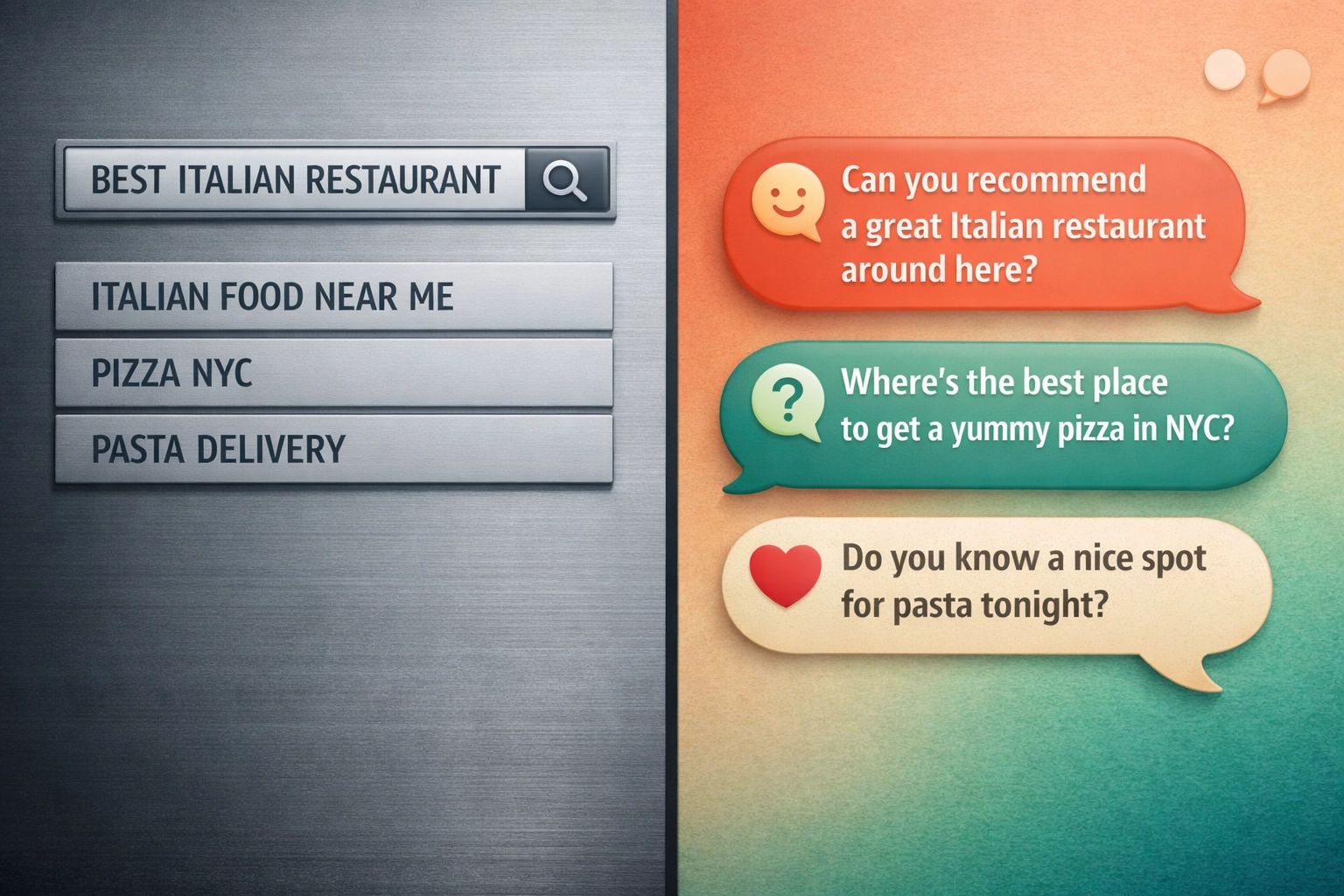
Here's a simple truth: people talk to AI search like they're having a conversation. "How do I fix a leaky faucet?" "What's the best digital marketing strategy for local businesses?" "Where can I find web development services in Texas?"
Your content needs to match that conversational style.
Add FAQ sections to your service pages and blog posts, but make them specific to what your actual customers ask, not generic stuff you pulled from a template. Use real keyword research and actual customer feedback to inform these sections.
Pro tip: FAQ sections perform exceptionally well for AI visibility because they naturally mirror how users phrase queries. Just make sure they're authentic. AI systems can absolutely tell when you're phoning it in.

Get Your Schema Markup in Order
Okay, "schema markup" sounds technical, but stick with me, it's basically just helping AI understand your content better.
Think of schema markup as labels for your website. It tells search engines, "Hey, this is a FAQ section," or "This is my business address," or "Here's what services we offer and how much they cost."
The three schema types you actually need:
- FAQ schema for your question-and-answer sections
- LocalBusiness schema for your name, address, phone number, and service areas
- Service schema to describe what you offer (with descriptions and pricing)
If you're on platforms like WordPress with the right plugins, or Squarespace, a lot of this happens automatically. If you're not sure whether yours is set up, that's exactly the kind of thing our SEO services for small business can help with.
Why it matters: Structured data reduces ambiguity. When AI systems can clearly identify what your content is about and who you are, you're exponentially more likely to get featured.
Keep Your Business Info Consistent Everywhere
This one's simple but critical: your business name, address, and phone number (what the pros call "NAP") need to be exactly the same across your entire website.
Not "Catelleon Solutions" on one page and "Catelleon Solutions LLC" on another. Not "123 Main St." on your contact page and "123 Main Street" in your footer.
AI systems build trust through consistency. When they see your brand mentioned the same way, connected to the same topics, across multiple pages and platforms, they build stronger associations between you and your area of expertise.
Action steps:
- Audit your website for NAP inconsistencies
- Update your About page to clearly establish your expertise and credentials
- Make sure your contact information is identical everywhere it appears
- Keep your Google Business Profile aligned with your website
Why it matters: Consistent entity associations signal to AI that you're a legitimate, trustworthy business: not some fly-by-night operation with sketchy information.
Keep Your Content Fresh (But Don't Obsess)
AI platforms love recent information. That dusty blog post from 2019? Not getting cited.
Set a quarterly reminder to review your top-performing pages and give them a refresh. You don't need to rewrite everything: just update statistics, add new examples, refine outdated advice, and maybe expand sections that could use more detail.
Even small updates signal to AI systems that your content stays relevant.
Why it matters: When someone's searching for current advice on local SEO strategies or the latest marketing tactics, AI systems prioritize content that's been recently updated. Fresh content = more citations.
Rethink Your Keyword Strategy
Keyword research isn't dead: it's just evolved.
Instead of chasing high-volume keywords that every big brand is fighting over, focus on:
- Intent-driven phrases that show what someone's actually trying to accomplish
- Long-tail keywords that are more specific and conversational
- Question-based searches (who, what, where, when, why, how)
- Conversational phrasing that matches how people actually talk
Monitor how your brand appears in AI summaries. If AI is consistently pulling from your competitors instead of you, that's a signal that your authority or content structure needs work.
Track What Actually Matters Now
Traditional keyword rankings? Still useful, but they don't tell the whole story anymore.
New metrics to watch:
- AI Overview appearances (when your content gets featured)
- Brand mentions within AI-generated summaries
- Direct inquiries from AI visibility (phone calls, emails, form submissions)
- Assisted conversions (when AI exposure influences buying decisions)
Google Search Console is starting to show some AI Overview data, though it's still evolving. The key is to pay attention to which queries trigger AI Overviews featuring your content, then optimize accordingly.

Here's the Best Part: Small Businesses Have the Advantage
Big brands can't fake what you have: genuine local expertise, real customer relationships, and the ability to be hyper-specific about what you do and who you serve.
Google's AI prioritizes relevance, local context, and clear expertise. Businesses that explain their services, location, and value proposition in straightforward language often show up in AI Overviews: even when competing with massive brands.
The shift away from pure ranking volume rewards quality and clear messaging. That's your wheelhouse.
If you run a local business, you're not competing with Amazon or national chains in AI Overviews. You're competing with other local businesses: and most of them aren't doing any of this yet.
What to Do Right Now
Don't overthink this. Start with these three things today:
- Audit one of your service pages and add a genuine FAQ section based on real customer questions
- Check your NAP consistency across your website and Google Business Profile
- Identify 2-4 core topics you want to own and map out content ideas around them
That's it. You don't need to become an SEO wizard overnight. You just need to be helpful, clear, and consistent.
Let's Make This Easier
Look, we get it: you're running a business, not a digital marketing agency. You've got customers to serve, operations to manage, and about 47 things on your plate right now.
That's exactly why we built our SEO services specifically for small businesses. We handle the technical stuff (schema markup, content optimization, AI readability strategies) so you can focus on what you do best.
Whether you need help getting your site ready for AI Overviews or want a full strategy for showing up in local search, we're here to make it happen without the headaches.
Ready to actually show up in AI search results? Let's talk about your specific business and build a plan that works for you: not some cookie-cutter template. Get in touch with us today and let's get your business the visibility it deserves.