
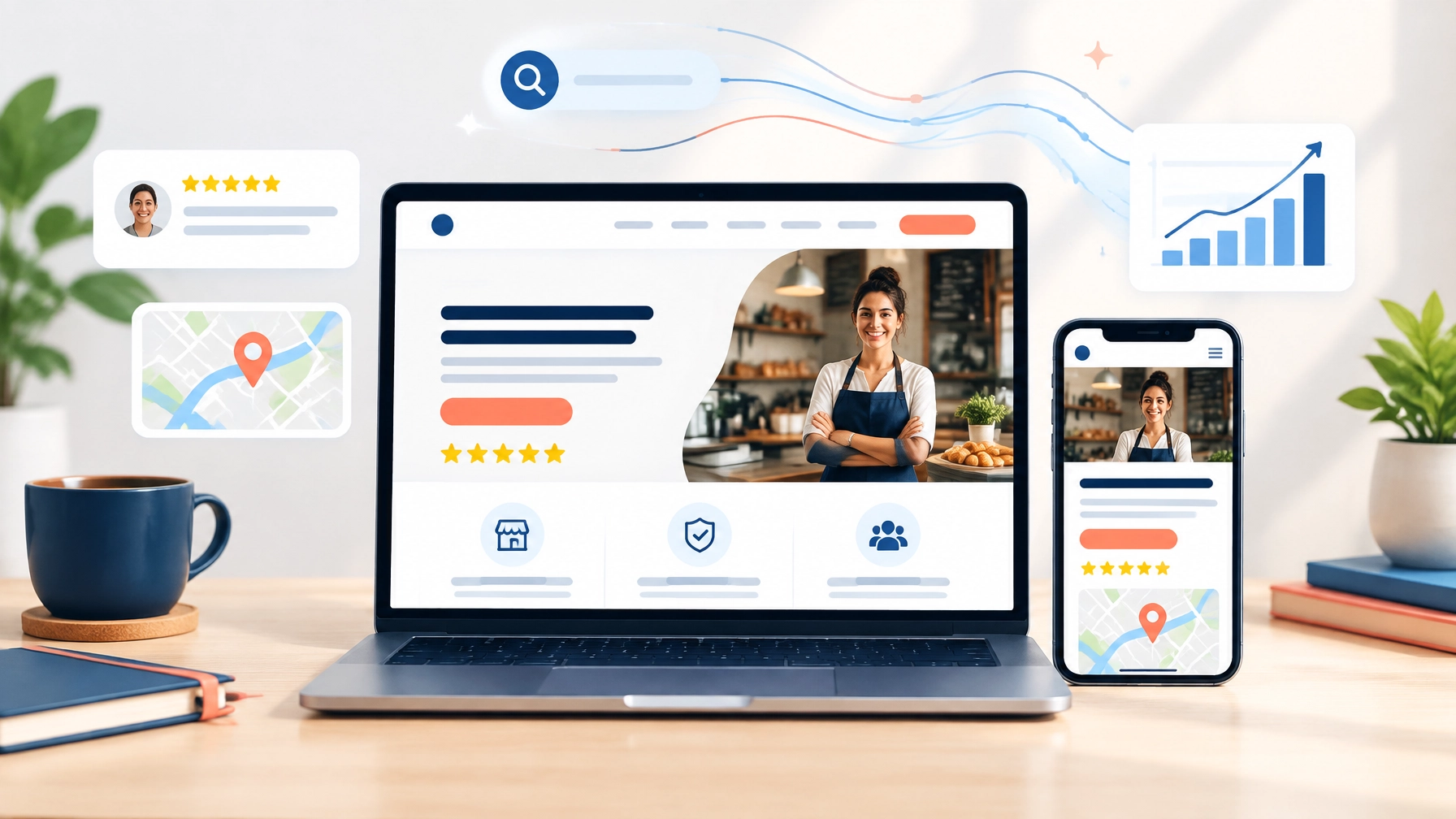
Hi there. Let’s talk about what makes a small business website generate leads in 2026-and what simply makes it more expensive.
A website can look polished, use the latest design trends, and still leave visitors wondering, “What exactly do you do, and how do I get started?”
The best small business web design is not about adding more. It is about making the right things obvious, fast, trustworthy, and easy to use.
The quick answer: what makes a website convert?
A high-converting small business website usually includes:
- A clear headline that explains what you do and who you help
- One primary call to action
- A mobile-first layout
- Fast load speeds
- Trust signals and social proof
- Strong local signals
- Simple contact forms
- Structured data for search and AI visibility
- Ongoing maintenance, analytics, and testing
You can usually skip heavy animations, bloated carousels, industry jargon, and endless redesigns without conversion testing.

9 Website Elements That Actually Convert
1. A headline that says what you do and who it is for
Your homepage headline has one job: help the right visitor recognize that they are in the right place.
Avoid vague statements such as:
“Elevating Possibilities Through Innovation”
That may sound impressive in a boardroom. It does not tell a potential customer what happens next.
Instead, make the message plain:
“Reliable HVAC Repair for Homeowners in Granbury and Glen Rose”
A useful headline answers three questions quickly:
- What do you offer?
- Who do you help?
- Where or how do you serve them?
Why it matters: Clear messaging reduces confusion and helps visitors decide whether to keep reading. If they have to decode your homepage, they may simply leave.
2. One clear primary call to action
Your website should guide visitors toward one obvious next step.
That might be:
- Get a Free Quote
- Schedule an Appointment
- Book a Strategy Call
- Request a Consultation
- Shop Now
You can include secondary actions, such as calling your business or reading a case study. But one action should visually lead the page.
Use specific button text instead of vague labels like “Learn More.” Tell people exactly what happens when they click.
Why it matters: Too many competing choices create friction. A focused call to action helps visitors move from interest to action.
3. A mobile-first layout
Your customers are not politely waiting at a desktop computer. They are finding you from phones, tablets, parking lots, couches, and occasionally the drive-through line.
A mobile-first website should include:
- Easy-to-read text
- Large, thumb-friendly buttons
- Click-to-call phone numbers
- Simple navigation
- Short sections with plenty of breathing room
- Forms that work without pinch-and-zoom gymnastics
Start with the phone layout, then expand it for larger screens.
Why it matters: A site that looks great on desktop but feels awkward on mobile is quietly turning away leads. Mobile usability also supports search visibility and overall user experience.
4. Fast load speed
Speed is not a decorative feature. It is part of your sales process.
Improve performance by:
- Compressing images
- Using WebP or AVIF formats
- Removing unused plugins and scripts
- Lazy-loading below-the-fold images
- Choosing reliable hosting
- Monitoring Core Web Vitals
Be especially careful with large background videos, oversized photography, and third-party tools that load before your main content.
Why it matters: Every extra second creates another opportunity for a visitor to give up. Fast pages feel more professional, more trustworthy, and easier to use.
5. Trust signals placed near decision points
People want to know that your business is legitimate before they contact you. Give them evidence without making them hunt for it.
Useful trust signals include:
- Customer testimonials
- Google review ratings
- Client logos
- Certifications and licenses
- Guarantees
- Before-and-after photos
- Case studies
- Team photos
- Clear contact information
Place proof near your calls to action. A testimonial beside a quote form is more useful than a testimonial buried on a separate page.
Why it matters: Trust reduces perceived risk. Visitors are more likely to reach out when they can see that real people have had a positive experience with your business.
6. Strong local signals
If you serve a specific city, county, or service area, say so clearly.
Your website should make your location and service area easy to understand through:
- City and region references on relevant pages
- A consistent business name, address, and phone number
- Embedded maps where appropriate
- Service-area pages
- Links to your Google Business Profile
- Local customer reviews
- Location-specific FAQs
This is where local SEO services can make a practical difference. Local search is not just about ranking. It is about reassuring someone that you actually serve their neighborhood.
Why it matters: A visitor searching for “roof repair near me” does not want a company that serves three states away. Local clarity improves both visibility and conversion confidence.
7. Simple forms and easy contact paths
A contact form should not feel like a tax return.
Ask only for what you need to begin the conversation, such as:
- Name
- Email or phone
- Service needed
- Short message
You can gather additional details later. Also include a click-to-call option, especially on mobile.
After someone submits a form, show a clear confirmation message. Tell them what happens next and when they should expect a response.
Why it matters: Every unnecessary field adds friction. A shorter form can create more inquiries while still giving your team enough information to respond intelligently.
8. Structured data for search and AI visibility
Search engines and AI assistants need help understanding your business.
Use clean page structure, descriptive headings, useful FAQs, accurate metadata, and relevant schema markup such as:
- LocalBusiness
- Organization
- Service
- Product
- Review
- FAQPage
Structured data does not guarantee that Google or an AI assistant will feature your business. It does make your information easier for machines to interpret.
Write answers in plain language. If someone asks, “How much does commercial landscaping cost?” create a helpful answer rather than hiding behind generic marketing language.
Why it matters: In 2026, visibility is not limited to ten blue links. Your website should be easy for traditional search engines and AI-powered search experiences to understand, summarize, and cite.
For a broader technical foundation, explore Catelleon’s SEO services.
9. Ongoing maintenance, analytics, and testing
A website is not a set-it-and-forget-it brochure. It is a working business asset.
Ongoing website maintenance services should cover:
- Software and plugin updates
- Security checks
- Backups
- Broken-link monitoring
- Form and checkout testing
- Mobile reviews
- Speed checks
- Content updates
Then connect those improvements to analytics. Track calls, form submissions, bookings, purchases, and qualified leads, not just page views.
This is the practical side of conversion rate optimization. You make a change, measure what happens, and improve based on evidence.
You can also revisit Catelleon’s article on your website as a leaky bucket for more ways to identify conversion problems.
Why it matters: Small problems become expensive when ignored. Maintenance protects your investment, while testing helps you learn what actually persuades your customers.
4 Things You Can Skip or Stop Paying For
1. Over-designed animations and graphics
Subtle motion can improve a page. A parade of sliding objects, auto-playing videos, and animated text can make it slow and exhausting.
Prioritize:
- Clarity
- Speed
- Accessibility
- Strong photography
- Easy navigation
Add visual flourishes only after the fundamentals work.
2. A bloated homepage carousel
Homepage sliders often rotate through several messages so quickly that visitors miss all of them.
Instead, use:
- One strong headline
- One primary offer
- One clear button
- Supporting proof below it
Your homepage does not need to be a digital slideshow presentation.
3. Writing for your industry instead of your customer
Customers do not always use your professional vocabulary. They describe problems in everyday language.
Replace:
“Integrated omnichannel demand-generation infrastructure”
With:
“Get more qualified leads from search, ads, and social media.”
Your internal terminology may be accurate. It may also be completely unhelpful to the person trying to hire you.
4. Endless redesigns with no conversion testing
A new color palette will not fix a confusing offer. A new theme will not repair a broken form.
Before investing in major website redesign services, identify the problem:
- Are visitors reaching the right page?
- Do they understand the offer?
- Can they contact you easily?
- Are forms working?
- Are you tracking conversions?
Sometimes the right answer is a focused landing page design improvement, not a full rebuild.
How AI Changes Small Business Web Design in 2026
AI is useful in web design, but it is not a replacement for business strategy.
You can use AI to:
- Create early wireframe concepts
- Generate headline variations
- Organize frequently asked questions
- Identify content gaps
- Summarize analytics patterns
- Suggest A/B test ideas
- Draft structured content for common customer questions
AI can help you move faster from a blank page to a workable starting point.
But a human still needs to own:
- Positioning
- Offers
- Brand voice
- Customer insight
- Pricing strategy
- Final messaging
- Business priorities
AI does not know why your best customer chooses you, or whether a clever headline is actually true.
Think of AI as a helpful assistant, not the owner of your website. Use it to create options, then apply human judgment to choose what is accurate, useful, and persuasive.
Need traffic to a page that is ready to convert? Catelleon also provides Google Ads management through PPC services, along with social media marketing services. Businesses selling online can also explore ecommerce website development.
How to Prioritize If You Only Have $1,000
You do not need to rebuild everything at once. Start with the highest-impact improvements:
Spend about $250 on a conversion and technical audit
Identify broken forms, unclear messaging, mobile problems, slow pages, and missing tracking.Spend about $300 improving your most important page
Rewrite the headline, clarify the offer, strengthen the call to action, and add relevant trust signals.Spend about $250 on performance and mobile fixes
Compress images, remove unnecessary scripts, improve spacing, and make contact options obvious.Reserve about $200 for tracking and follow-up
Set up conversion goals, form notifications, call tracking, or a simple lead-management process.
The exact numbers can change. The principle is what matters: fix clarity, friction, speed, and measurement before purchasing expensive extras.
Build the Website Your Customers Need
The strongest small business websites in 2026 will not necessarily be the flashiest. They will be the ones that are:
- Clear
- Fast
- Mobile-friendly
- Trustworthy
- Locally relevant
- Easy for search engines and AI systems to understand
- Maintained and improved over time
If your website needs a stronger foundation, our digital marketing services can support SEO, PPC, content, social media, and conversion-focused improvements.
Let’s talk about your project: we’re listening. Contact Catelleon Solutions today.